Tuesday, July 29, 2008

Busy, busy, busy

Some photos:

A working mother taking a quick break from ploughing.

Introduction to a skit at the girls' camp.

One of the campers, reading on the dock. Beautiful area by the mangroves near Sokone.

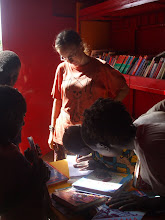
Learning about Martin Luther King, Jr. His "I have a dream" speech was translated into French in these booklets, along with other information about the Civil Rights Movement. If you want to learn more about the program that put on this camp, go to 10,000 Girls' website: http://10000girls.org/

It's been a fabulously busy three days! The bus from Kolda dropped me off near
Kaymor, where I spent the night with Kate. We slept until 9:30, a ridiculously late time here in Senegal, but we were so tired after the Ag meetings! And sleeping in just one day is incredibly refreshing. The next morning I wrestled with vetiver grass, which was the reason I'd gone to Kaymor. Vetiver is a kind of grass that is very hardy, with a fragrant root system. It's supposed to work well when planted in water erosion sites, to catch the fleeing topsoil that would otherwise be washed away. It is, however, difficult to get out of the ground, as I discovered after sweating and hacking at the stuff with a machete. Still, I got enough to bring home to Keur Ali Gueye, and worked with a couple farmers transplanting it in their fields, perpendicular to the eroded ditches. They're flimsy little sticks now, but if all goes well they will plump up, spread out around the central piece, and inch'allah make an effective blockage that will make it so they can farm between the walls of vetiver, increasing the useful area of the field. That's the theory, anyway. The farmer who'se working on neem pesticide solution has kept it up, which is great, and his beans are bushy and green. Though I attribute that to his farming skills more than my neem solution. Tis also the season to outplant trees. I've gotten pretty militant about it, because the common refrain here is, "Later, later, we'll do it later," which gets me very worked up until I'm insisting, "No! Leegi LEEGI!" which means "now, RIGHT NOW!". It doesn't get me very far, though. However most of the vetiver got in the ground, and just yesterday I assisted at the planting of a twelve-tree cashew orchard. Not very big, but it looks so pretty and well-spaced. I hope they survive! At least better than the poor papayas. Probably five, maximum, have survived outplanting. The major killer being goats, of course. C'est la vie. My little test plot, however, looks fabulous. ECHO's basil and sesame seeds shot up and are growing nicely. Here's ECHO's website, too: http://echonet.org/ They're a great resource for us Agriculture Volunteers. For the moment that's all, but my goal before the end of the week is to outplant ALL my trees, and hopefully organize the two farmers who want live fences to drive charrettes to Eaux et Forets in Nioro to pick up their thorny species, and visit all the fields of Peace Corps ISRA seed. Can I do it? I think so! But I should really stop being so American. A "to-do" list, trying to check off things as they happen, can only end in tears here in Senegal.

Thursday, July 24, 2008

Democracy Camp & Ag Summit

It's been a busy couple of weeks! And I've only been able to spend one full day in my village since last Monday, because the activities have been taking place elsewhere. But my little demo plot is growing well, everything sprouted nicely, so I'm excited to get back to it. Visiting the fields is more fun now, too, because everyone is out there working most of the day. I'm learning to weed and thin with the "ngosi", a hand tool, which is laborious but effective. Finally, there is enough green material growing for animals to graze, so I hope our poor, bony horses start to fill out soon too. They're working just as hard as the people! Anyway, last Monday I took two girls from the village to Kaolack. The same program I'm working with on the bookmobile (10,000 filles) was putting on a five-day camp to discuss democracy, human rights, and gender equality. The camp was led entirely in English, by a group of college students from Goshan College. They did an awesome job! Though the village girls obviously don't speak English well (most not at all) we helped organize tables to mix them in with girls from Kaolack who did, and thus get the information translated. Kate and I were the two Peace Corps Volunteers there. Our role was to advise the students when they had questions about the activities they'd planned, and to be a translation resource if the girls had questions that needed answering in French or Wolof. The camp consisted of discussions, in which the girls participated fabulously well, and also games and activities. Some educational activities were writing mock political platforms (If I were President of Senegal...), and designing a flag representing democracy, and poetry writing on one of the Universal Human Rights (one girl wrote a stunning poem, in English, about how humanity transcends national boundries and differences in skin color; it was so good! Really blew me away.), and a collage project addressing stereotypes of women (these turned out amazing, too) there was also reading articles about Rosa Parks and Martin Luther King, Jr., and talks led by the very educated Mme. Vaughn (founder of the NGO) about what Islam teaches about gender equality. There were ice-breaking games, too, and possibly the highlight: group skits about womens' rights, all done in English, with the girls helping one another to understand. The skits turned out wonderfully! The girls really enjoyed it, and I could see them blossoming and gaining confidence each subsequent day of camp. It was a totally alien environment for so many of them, but they got so much out of it, really learned a huge amount, interacted with one another, and had a great time. One of the best things for me was Wednesday evening, when we built an American-style campfire. Somehow they'd found marshmallows in Kaolack, and bought butter cookies and chocolate spread. Thus, we introduced 30 Senegalese teenagers to the deliciousness of s'mores. Oh, they loved them! And I'm sure it was the first time any of them roasted a marshmallow over an open fire. After the gooey dessert, we had story time. Kate recited versions of "Goldilocks and the Three Bears" and "The Three Little Pigs", which I translated into (pretty awful) Wolof as "Fatou and the Three Hyenas" and "The Three Little Chickens and the Big, Bag Dog". I think my imperfect language skills made the girls laugh all the harder. The stories were acted out by the Goshan students, which was hilarious! Everyone had a marvelous time that night. In short, the camp was a huge success.
As I write this I am actually in Kolda, a city to the South of The Gambia. We just finished our last day of the Sustainable Agriculture Summit, which was a really useful three days of discussion about the agriculture program, reviewing the project plan and going over possible activities for the rainy season. Kolda is very different from the area I'm used to. It is lush and green, covered with trees, and the melodic sounds of the Pulaar language are more common here than Wolof. The huts in the surrounding villages are round, with thatch roofs reaching halfway down the sides, so they look like fat toadstools. I think it's adorable! And though corners are handy for propping up things like bookshelves and beds, I rather envy the Kolda Volunteers their novel circular huts. Going through The Gambia to get here was an interesting experience, too. It took around two hours, border to border, which included waiting for a ferry to carry us across the river. I had a tasty grilled chicken sandwich at the dock: grilled chicken, macaroni, fried potatoes, lettuce, tomato, and ground black pepper, all for only 500cfa. A marvelous treat for only "temere"!

Saturday, July 12, 2008

Farming

It's been a busy week! We had a couple good rains the past few days, which means more trips out into the fields. By now most of the crops are big enough that almost everybody has a role to play. The machines are still at work, troweling the ground to pull of stubborn weeds and cover seeds with dirt, but there is also work to be done by hand. In the morning, everybody who can hold a handhoe heads out into the fields to dig around each individual crop, row by row, raking away weeds and grass. I've managed a row or two, but it's an exhausting, tedious task; bent over at a 90-degree angle, scraping away in the soil. But, it's good to have things to do! After the first nice rain I finally seeded the test plot in my backyard. I planted mint in one of my tires, and also a plot of beans near my concrete douche, and also cabbage, onion, collard greens, beets, and bissap in my garden. Nothing has sprouted yet, and it maybe never will; I am not an experienced gardener. But I thought I might as well try. Out behind my house, in the area reserved for me by my counterpart, I am practicing a no-till farming technique. Only working the ground where I'm seeding is the idea, leaving all the rest at Nauture's mercy. So I have a few rows of beans, come corn in zai holes, and four short rows of sesame. The seeds came from ECHOnet, an excellent organization that is a resource for lots of agriculture Volunteers. Also, I transplanted some of their basil. Basil grows fabulously here! And it smells so good too. Now one of the test fields is being treated with neem-leaf solution as a pest repellent, twice a week, and we're going to thin the millet test plot tomorrow hopefully, so people can observe what thinning method produces best. Once the corn grows to knee-height we'll plant the cover crop, lablab bean, in-between rows. It's supposed to serve as a green manure and protect the soil, as well as supplying edible beans. We'll see how all that goes. But, meanwhile, the evenings are cool, the mornings dewey, and I'm enjoying my time walking to and from the fields.

Tuesday, July 8, 2008

Slowly, slowly

It's been a pretty dry week, though people are still seeding and working the ground. Now the crops must push up their tender sprouts through a crust of cracked, dry mud. About half of the farmers I'm working with have seeded their Peace Corps improved seed; one corn field is shooting up nicely, and the beans of course look great. They're easy to please. However right now it's mostly men and work animals in the fields. Only a few are big enough for the women and girls to go in with their hand tools to weed. So I mostly wander around, poke about in the dirt if there's something I can help with, and stare indulgently at the baby crops. I'm waiting for one more good rain to settle the soil, so I can seed my own little backyard garden and demonstration plot of zai holes, out behind my hut. But, there are things to do. Yesterday I accompanied my pilot farmer on the first neem solution application to his beans, and tomorrow we'll thin his corn. Soon, the women's group will plant their bissap field. My recently-seeded cashew pepiniere looks wonderful! They're really taking off, popping boldly up out of their little black polysacs. Around the first week of August they'll be ready to outplant, and I have several people interested. Of course, there was a lot of interest in the papayas, too, but after all were put in the ground, maybe only four or five have taken. One of the big problems is goats. Despite talking myself hoarse and giving suggestions for protecting the trees, they are very likely to be beaten by the sneaky goats. Goats are a depressing fact of life in Senegal.
One interesting thing that happened this week was a wedding. Earlier in the blog, I described the event where a young women left the village to go to her husband's house. Well, this is the flip side of that: a new bride coming into the village. She is the second wife of a man in my neighborhood, and it was very interesting to watch the ceremonies. I barely understand any of what's going on, but I do my best anyway. This time, the women got all dressed up accompanied the bride around the quartier to greet the imporant people. She had her head and face covered with a heavy, ribbon-embroidered cloth, which was held by the first wife, who led her new co-wife to and from the houses. Later, the women got to work cooking lunch and dinner. I contributed by chopping probably two dozen onions, which involved slicing my thumbs signifigantly, and my skin absorbing the scent of onions, which still hasn't worn off yet. But it was a tasty sauce! Meanwhile, the bride and the first wife were in another compound, getting dressed and made-up. We went there in the afternoon, where both women looked stunning, with elaborate hair and sparkling eyeshadow, wearing fantastic clothes. Then, the neighborhood women started singing as they escorted the two along the road, towards their house. It was a slow procession, but not serious; there is always a lot of joking, arguing and laughing in any village event. Coming to the husband's house (he, by the way, was somewhere else entirely during these whole proceedings; I have no idea what the men do on these occasions) there were clothes laid on the ground, which we walked on, as the bride was formally welcomed home. In the evening, of course, was dancing - my petit pagne is a celebity at such events, and I was forced to dance around a few times to show it off. The next day, the bride was led to the well (once again, with her face covered, guided by the first wife) to symbolically wash her laundry; the day after that (again dressed in her most beautiful clothes) she pounded millet. All daily activities in the village, made ceremonious because it's the first time she did them in Keur Ali Gueye.

Sunday, June 29, 2008

Wet

I awoke this morning to find that my village had become a swamp. To backtrack: since my last dramatic installment (the wind that blew my roof off, with enough rain to soak my bed but not penetrate far into the soil) there has been no rain to speak of. The fields waited, dry, and the men and boys returned to relaxing. There were many cloudy days, but no rain. Then finally, the day before yesterday, it happened. It was the late afternoon when the clouds started gathering in earnest, congealing into heavy, bruise-colored clumps low on the horizon. That day, the village children paraded through the streets, singing - so I was told - to bring on the rain. And it woked! At the beginning, there were only a few timid drops, and people went on with their chores, pounding millet and stripping nebedaye or baobab leaves for dinner as usual. But graually, the rain gathered force, until it came at last in an impressive waterfall that ran in thick rivers across the packed ground. Thunder and lightning added drama to the already-thrilling scene; the excitement in people's faces was contagious. Everyone grinning from ear to ear, whether they were dancing in the shower (like many of the giddy children did) or just sticking their heads out the door to watch the droplets fall from the straws of the roof. I stared out at my backyard, which gathered water at a surprising rate, washing swiftly over the grassless ground, over the flimsy green trunks of my recently-planted trees, and splitting to avoid my compost pile. After the main deluge had reduced to a tolerable trickle, I went outside to join the neighbors. Everyone was standing around on bits of high ground, watching the water run downstream towards the fields. My counterpart was so excited, he called me over and grabbed my arm to point out into a field behind the village, where we could see the sheen of water gathering. My host mom was laughing; many of the kids ran in wrapped in towels from where they had bathed in the downpour. Nothing but happiness all around. The frosting on the cake, for me, was yet to come. Only minutes afterward, the sun burst out from behind the westward clouds, creating an enormous, gorgeous rainbow in the east. It was a perfect arc, touching the ground on both sides, with all the colors bright and beautifully clear. One of the most flawless rainbows I have ever seen. The rain came again that evening, and the next day people headed out to the fields. I, too, went to work, visiting the nine farmers to whom I gave improved seed to test this season. I made sure to distribute the seeds last week, so everyone has what they're assigned, and they saw my germination tests so they know what to expect in that regard. Dotted all over the land were sillouettes of people, walking behind seeding or tilling machines, or urging on their work animals - horses, cows, and donkeys. I visited some of the fields that will be seeded with Peace Corps seed this year, so I can make notes about their performane during the coming season. But most people are busy with sowing peanuts at the moment, as that is their primary crop. Last night, then, came the real deluge. It rained so hard and so long, it filled up each of my buckets half-way! This also created huge expanses of standing water in the lower parts of the land, along the roads and in the depressions around trees. Walking out this morning, I heard the humming of frogs, who have appeared in legions overnight, and saw the puddles all around. Everywhere I walked were tiny, spring-green shoots pushing up through the wet sand. Birds fluttering and chirping everywhere! As I said, when I went out this morning, it was no longer into the dry Sahelian brush; it was a vertiable wetland. Now the real work starts for us all.

Wednesday, June 18, 2008

Photos and friends

Note: these should really be looked at up bottom to top; they were added in reverse. Enjoy!
Hugging a majestic baobab tree in Toubakouta.

Heather and Adam enjoying the lunch they bought for the village. Noos yu bare! The goat was cute, and also delicious. Very oily meal; they used seven liters.Janet Lane comes to Senegal! Her new book, "Emerald Silk" was excellent. It has now joined the hallowed shelves of the much-frequented Kaolack house bookcase. Like to read much?My counterpart filling a shift in one of the village boutiques. I think it's time for me to display some images of a few of the fabulous people I work with. These are my two good friends Kate and Wanna, making lotion in my backyard:

Home is where the Hut is

It's funny, but actually I am more at home now in a village, carrying a bucket of water on my head, than I am in Dakar where there is television and restaurants open late. Coming back to the village after a long series of outside activities made me appreciate anew the unique place it is, and how lucky I am to be having this experience. There really is nothing else like it. As I walked the seven kilometers from Nioro to Keur Ali Gueye, I passed fields newly tilled, and the few patches of fallow land are covered in a fuzz of emerald grass. All these are signs that the rainy season has officially started. This was announced to me in a rather shocking way late Sunday night, when a storm of thunder, lightning, wind and rain began to rage. At first I felt cozy in my hut, but soon, I began to feel a dripping coldness, and realized that there was a huge leak in my thatch roof - right over my bed. The rain was really coming down, and the gale was blowing hard, so I really could do nothing but get up and watch my mattress become drenched by the steady stream of droplets from the ceiling. By the time it was over, there was only one relatively dry spot; the rest of the bed was completely saturated. As we discovered in the morning, the wind has blow off the top of my roof, creating a sizeable hole. So, we tied the straw down with ropes, and I bought some plastic lining that we'll install today. Hopefully that should keep me dry for the rest of the season.
The morning after that big storm, all the men and boys of the village gathered their seeding and tilling machines, hefted sacks of peanut seed onto carts, and hitched up all their horses and donkeys. All day there was a stream of the going to and from the fields, seeding this year's crop of peanuts. It's all done by manpower, with a significant contribution from the horses, cows, and donkeys. The village is pretty much cleared out by every male over the age of five until lunchtime, when they finally come home to rest in the heat of the afternoon. I have yet to try my hand at plowing or planting, as my time has been occupied in the village with a variety of little projects: visiting the gardens where two farmers want to install a live fence (we'll plant it after a few more good rains, inch'allah), monitoring my germination test (the millet came up fantastically well, the beans too; corn did fine but sorghum is pretty pathetic) and planting trees. With the help/hinderence of the inevitable mob of children, we have outplanted about ten papayas, a few nebedaye, some "dank" (a rather dry, bland, fibrous green fruit with a huge pit), and my host father wants to plant the jitropha along the side of his backyard field sometime soon. I have also put a tree every few meters along my own backyard fence which, when they grow big enough, can be used as posts to tie the fence to. At the moment people use dead wood, which often falls down, as we discovered during another windstorm. Two whole sides of my millet-stalk fence blew over that time. Also, the NGO Tostan is doing a project with twenty village women to start up a savings-and-loans club, so that is an exciting new thing to observe. As the rain arrives, too, so do the mosquitoes. Therefore, it's time to start combating the inevitable malaria. Several programs are in place to attempt to reduce cases of the disease: a group will come through the villages to spray rooms with insecticide that is supposed to last throughout the rainy season. Another group will hand out coupons for free mosquito nets to mothers of children under five, which they can pick up at Postes de Sante in surrounding towns. Hopefully I can also do a formation on making neem lotion, which acts as a repellent. In addition to that, I must soon distribute the improved seeds to my village's chosen farmers, and start monitoring their fields, as well as setting up demonstration plots of new techniques to try. So, there's plenty going on! Also, the bookmobile project is getting going. I have meetings coming up about that in the next few weeks as well. As soon as the rains come, so does the work! It feels really good to be back in the village, though. I missed it, and always come back with a really positive feeling. Everyone is excited to see me, and I them; for now, this place is my home.
My annoying foot infection came back once I returned, though, so I'm still treating that. However, having it means I got a great insider's experience of traditional healing practices. My host father was very concerned about it, so he first gave me a red, white, and black thread to tie around my ankle, "to help pull out the infection". This was followed by two mornings of murmuring, spitting, and waving his hand over the wound; also, chewing up "nettattue" (I have no idea what this is; they look like little brown seeds, and are used in cooking) and patting the slimy mixture around the spot, "to draw out the fluids", and finally drinking several rounds of tea made from a leaf he brought me from the bush. Anyway, thanks to those treatments, continued hot soaks and antibiotics, the thing seems to be on its way out finally. I won't be the one to say those healing efforts didn't help it along!